
To support your global practice, ACC Docket offers country-specific fun facts from your peers who’ve been there — literally.
| Economy | GDP (purchasing power parity) US$189.582 billion |
| Population | 4,424,762 (2016 estimate) |
| Corruption | According to Transparency International’s 2017 Corruption Perception Index, Oman ranked 68th “cleanest” (i.e., least corrupt) out of the 180 countries surveyed. |
| Additional Resources | Oman tourism |
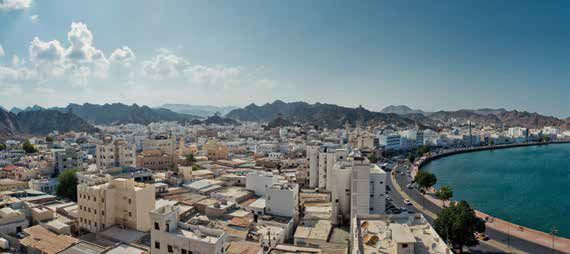
The Sultanate of Oman, a land of deserts, mountains, beaches, and spectacular fjords, is a well-kept secret. The vast, almost mythical, grandeur of the Empty Quarter (the towering red sand desert that famously intrigued British explorer Wilfred Thesiger) is found in the southwest of the country; while, in the north, stunning mountains (like the majestic Jebel Al Akhdar, where locals grow roses in temperatures up to 15 degrees cooler than sea level) line the Gulf of Oman, and well-heeled tourists sip drinks in discreet, upmarket hotels before whale or dolphin watching or sampling some of the finest scuba diving in the region.
Oman’s empire once stretched from East Africa to India, and its dhow sailors traveled perhaps as far as China (the Omanis claim, a little fancifully, Sindbad as one of their own). In its souks, or markets, you are as likely to hear Swahili and Urdu as well as Arabic and English. At the souk in Muttrah, you can haggle over the frankincense grown here since the time of the Queen of Sheba and watch Omanis in traditional dress with distinctive caps. You may even see some of the older men wearing beautifully crafted silver khanjars (daggers with broad curved blades) thrust into their belts. It is dotted with old forts and ancient villages that transport you back to the days of old Arabia.
If you find yourself in Oman for business, you are almost certain to travel to Muscat, its capital. Its airport is one of the swankiest in the Gulf and opened earlier this year.
Old Gulf hands will tell you that Omanis are arguably the nicest and gentlest of all the Gulf Arabs. They are generally thoughtful and considerate. They speak softly. They avoid confrontation. They do not like loud, boorish behaviour. They abhor arrogance. Oman is the least sectarian of all the Gulf states. Christians, Hindus, and other minorities (including the Shia minority) are free to worship as they see fit, without interference.
In a part of the world that is sometimes difficult to navigate, Omanis quietly pride themselves on behaving in a principled and even-handed manner with all their neighbours. They are friends with the Saudis, Emiratis, and Americans on the one hand; and the Iranians on the other. When the Americans and Iranians decided to enter backchannel talks that led to the Iran nuclear deal, these delicate discussions were held in Oman because both sides trusted it equally.
Meetings typically start on time. In keeping with the courtesy that is a hallmark of Omani society, they usually begin with some gentle, polite words of introduction before progressing to the matter at hand. In a business context, most (but not all) Muslim women will shake hands with men. When introduced to a Muslim woman at a meeting, watch carefully to see if she offers her hand for a handshake. If she does, smile and shake it. Alcohol and pork are permitted for non-Muslims. Whilst Omanis are famously tolerant and hospitable, it is a good idea to get to know them first before consuming these items or smoking in front of them.