To support your global practice, ACC Docket offers country-specific fun facts from your peers who’ve been there — literally.
| Economy | GDP (PPP) US$1.204 trillion (2017 estimate) |
| Population | 100 million (2018 estimate) |
| Corruption | According to Transparency International’s 2018 Corruption Perception Index, Egypt is the 35th “cleanest” (i.e., least corrupt) out of the 180 countries surveyed. |
| Additional Resources | Egypt Tourism Authority |
The Arab Republic of Egypt is a country spanning the northeast corner of Africa and southwest corner of Asia by a land bridge formed by the Sinai Peninsula. Egypt is a Mediterranean country bordered by the Gaza Strip and Israel to the northeast, the Gulf of Aqaba to the east, and the Red Sea to the east and south, Sudan to the south, and Libya to the west.
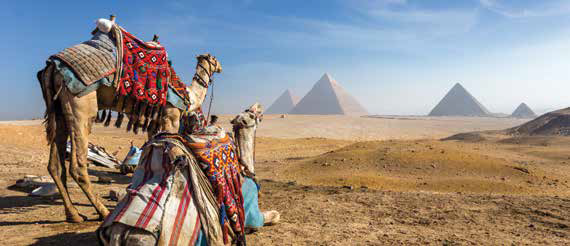
Egypt has one of the longest histories of any country, tracing its heritage back millennia. Considered a cradle of civilization, Ancient Egypt saw some of the earliest developments of writing, agriculture, urbanization, organized religion, and central government. Iconic monuments such as the Giza Necropolis and the Great Sphinx, as well the ruins of Memphis, Thebes, Karnak, and the Valley of the Kings, reflect this legacy and remain a significant focus of scientific and popular interest.
This great ancient heritage is now reflected in the current legal environment. Egypt’s parliament celebrated its 150th anniversary in 2016. Dr. Abd el-Razzak el-Sanhuri, an Egyptian legal scholar and professor, drafted the revised Egyptian Civil Code of 1948 and also lent his expertise to the civil codes of other Middle Eastern countries such as Iraq, Lybia, Kuwait, and Jordan.
Lawyers are well respected in Egypt. Some are classified as litigators and mainly interact with government authorities, representing their clients in different stages of courts. There are also corporate lawyers, who work as in-house counsel in multinational and private equities.
In early 2017, the Central Bank of Egypt (CBE) announced that it had fully floated the Egyptian pound (EGP). The decision to “liberate exchange rates” and move away from the long-standing partially pegged EGP envisages a return to foreign currency trading in the formal banking sector. Less than a month after flotation, the banking sector had pulled in more than US$3 billion, as reported by the CBE. Because of this decision, many companies decided to use their Egypt offices to serve North African countries and greater Africa.
Egyptians are well known for their friendly attitude, hospitality, and generosity, especially when it comes to food. Maps are not needed — just ask anyone for directions. In restaurants, waiters will recommend the best dishes and advise you when to stop ordering (served quantities are usually big). Cairo (the capital) and Alexandria (the second largest city) streets are usually very crowded; this brings a resigned attitude toward delays. Arriving 10 minutes late is usually tolerated and considered understandable.
The official language in Egypt is Arabic, and it is the only acceptable language to judicial authorities. Egyptian Arabic is the commonly spoken language, but English is often understood in big tourist cities as well.