| Economy | GDP (purchasing power parity in USD) $130.831 billion (2016 estimate) |
| Population | 10,982,754 (2014 estimate) |
| Corruption | According to Transparency International’s “2016 Corruption Perceptions Index,” Tunisia is the 75th “cleanest” (i.e., least corrupt) country out of the 176 surveyed. |
| Economic forecast | Growth in Tunisia is projected to improve in 2017 and 2018 when investment will be stimulated by the new law on investment and other laws recently passed in parliament. The relatively robust performance of the manufacturing industry should boost job creation. Unemployment will nonetheless remain very high, especially in underprivileged regions and among young graduates. This disparity is raising inequalities. The current account deficit will remain large, the threat of terrorism continues to weigh on tourist arrivals, and low growth in partner countries (largely EU members) restricts exports, according to the Organisation for Co-operation and Development. |
| Additional resources | Tunisia’s official tourism site |
| Paul Klee, August Macke, Louis Moilliet: The Journey to Tunisia 1914, an art history book about how the Tunisian landscape influenced artists 100 years ago. |
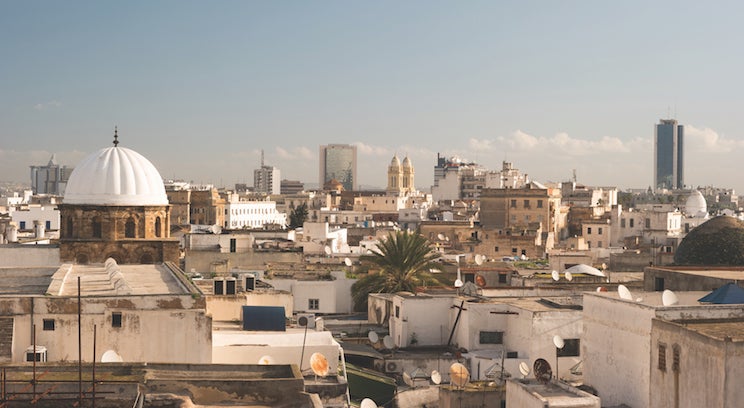
Tunisia is strategically located at the African conjunction of the western and eastern parts of the Mediterranean basin. With its 1,300 kilometers of coastline and thousands of historical sites, Tunisia is one of the favourite destinations for European tourists who enjoy its sandy beaches, friendly population, and delicious cuisine. Business travelers can also enjoy the hotels and commodities offered for congressional tourism as well as the seawater spas and golf courses in the capital city of Tunis.
Lawyers are well respected in Tunisia because they are associated with important events in the modern history of the country. In fact, the first president of the Republic of Tunisia was a lawyer, who also presided in the assembly that enacted the first constitution of the country. Our current president is also a lawyer.
During the Arab Spring revolution in January 2011, the country’s bar association opened its doors to demonstrators running away from police, and 95 percent of Tunisia’s 8,000 lawyers went on strike to protest against the repression of the demonstrators by the police. Subsequently the bar association was part of a peaceful political process and was awarded the 2015 Nobel Prize for Peace in recognition of its role.
Today, many Tunisian lawyers are very active in the field of human rights and are influential in the country. Others are pure business lawyers who practice either privately or in in-house legal departments.
When attending a business meeting, a five- to 10-minute delay is tolerated — especially if the meeting is in the center of the city, where traffic is usually congested. The standard dress code for meetings is formal; however, it largely depends on the venue. There is no special dress code for women in meetings or during a visit in Tunisia.
Tunisia is an Arabic-speaking country, but French is broadly spoken. In fact, most local administrations accept legal documentation and ling documents drafted in French. Online resources (request forms, procedures, laws, etc.) with the official Ministry of Development, Investment, and International Cooperation are generally available in English.