Banner artwork by VideoFlow / Shutterstock.com
The average car buyer knows a handful of things about engines. They know their car should have one. They know that a new one is better than an old one. Maybe also that a V8 brings more oomph than a V6. But if asked about the chemical and mechanical processes behind internal combustion they’ll probably shrug.
And that’s fine. To buy a car, even to buy an engine, you need to know certain things, not everything. If the subject turns too technical, you can look to experts — like Consumer Reports or Car and Driver — to fill in the blanks.
Businesses today rely on technology more complex than internal combustion engines. Computers, networking equipment, email, video chat, artificial intelligence, and countless other hardware and software.
For in-house counsel negotiating tech agreements — software licenses, SaaS agreements, and so on — that complexity complicates contracting. It makes it more challenging to identify risks, allocate responsibilities, even select the right template.
For in-house counsel negotiating tech agreements — software licenses, SaaS agreements, and so on — that complexity complicates contracting.
That worn old saw — that we became lawyers because we stunk at math and science — won’t excuse you from handling these agreements. But worry not, just as an automotive greenhorn can still negotiate pricing on their next car, you too can tackle tech deals without a PhD.
Here are five tips for doing so.
1. Ask dumb questions
Of course, there are no dumb questions. But there are questions we hesitate to ask out of worry we’ll seem simple. What is a “platform”? What do you mean by “data”? What’s “AI”?
Get over the worry. If you don’t understand the tech or terminology, unclear descriptions are just as likely to blame as your technical ignorance. Tech companies market their offerings with vague, buzzy language — “solution,” “platform,” “AI.” These terms lack fixed or obvious meanings; they’re unhelpful for attorneys trying to distill legally salient product features.
Your internal team’s descriptions may compound the confusion. People who write clean, elegant computer code can’t always bring that same clarity to their communications with laypersons. They may drop acronyms like “API,” “AWS,” or “AES,” without bothering to explain them.
If you don’t get the basics of the technology — what it is, how your company uses it — don’t just nod your head. Hone your deposition skills instead. Ask open-ended questions (e.g., “how does this work?”), then probe deeper. And if you still don’t understand, keep probing. One technique is to ask the person to explain the tech as if you’re a smart fifth-grader. Or say you’re a kindergartener if that’s the level of plain-speaking you need.
If you don’t get the basics of the technology — what it is, how your company uses it — don’t just nod your head. Hone your deposition skills instead.
And here’s the thing: chances are, you won’t be the only one glad you asked your questions. Often everyone assumes everyone else knows more than they do; imposter syndrome afflicts as many as the common cold.
Asking a “dumb” question can dispel it. So next time you ask one, don’t be surprised if a colleague chirps in: “You know, I was wondering the same thing.”
2. Do your research
Even with good questions, the descriptions you get from your colleagues or the tech provider may not suffice. The company selling its product may omit info that it worries could complicate the deal — for instance, whether a tool processes personal information. Your internal team may do the same. More charitably, they might just hold a different view about what’s relevant for their lawyer to know.
So, couple your questions with independent research. Google the technology, check the provider’s website, read the product documentation. AI tools like ChatGPT can also help. Give AI the same prompts that you would your colleagues. For example: “I need to review a SaaS agreement for Vaporware’s new AI platform. Explain in bullets what the technology is, how it works, and any other information that a contracting lawyer would need to know. Use language that a fifth-grader could follow.”
Give AI the same prompts that you would your colleagues.
3. Get shown, not told
If you’re still in the dark, you can supplement verbal descriptions with demonstrations.
Many software providers include video demos on their websites showing how users actually use their products. Or set aside 15 minutes with your tech colleague; have them share their computer screen and walk you through the tool.
Either way, seeing technology in action usually tells you more than any description can. A picture is worth … whatever, you get the point.
4. Make a simple model
Look up a diagram of how generative AI works and you’ll find complicated flowcharts with polygons, arrows, and terms like “denoising diffusion probabilistic models,” “backpropagation,” and “neural networks.”
Such diagrams are detailed, accurate, and — for in-house counsel negotiating deals with Gen AI companies — way more complicated than they need to be.
Generally, contracting lawyers need to know only those technical details relevant to assessing legal obligations and allocating risks and responsibilities. That means making a mental model much more abstract than a technically accurate diagram.
For instance, here’s my chart showing how generative AI works:
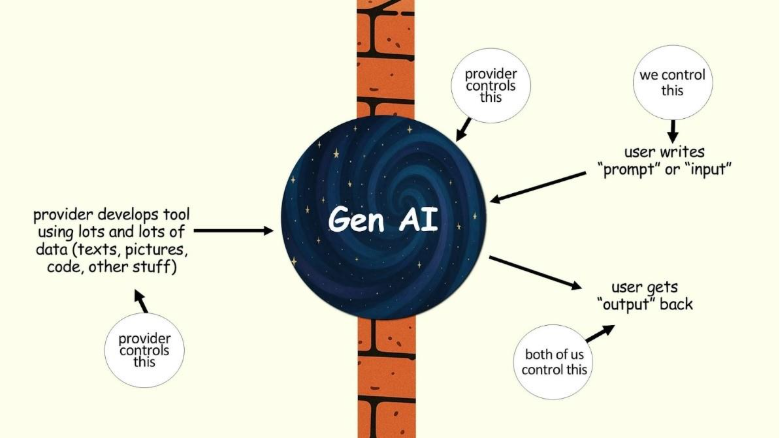
The chart is ugly and simple, even simplistic. It also conveys most of what you need to know about generative AI in order to negotiate liabilities in a provider’s contract.
As with buying a new car engine, you don’t have to know everything — just the stuff that matters for your needs. Simple models break things down to the essentials.
5. Fall back on rules of thumb
However much you learn about unfamiliar technology, you still won’t be an expert. And if you’re facing a constant onslaught of new contracts, you may not even have time to gain much knowledge at all.
In that case, you can fall back on some contracting rules of thumb. Like: If you’re licensing software, seek warranties about noninfringement, security, compliance with laws. If you’re giving your counterparty data, impose restrictions on how they handle that data. Even more basic: Move liabilities and indemnities from you, to them. Cap your liability; uncap theirs.
Redlining with such a thick marker means missing nuance. For instance, if you shift all liability for infringing outputs onto a generative AI tool provider, the provider may push back. Infringing outputs, they may say, can stem from user prompts too.
So what. The approach just means you put the onus on your counterparty to explain their contractual needs. It may cause more negotiation — so an informed approach remains best — but it seldom materially backfires.
Conclusion
The quick pace of in-house work means that lawyers often make decisions based on incomplete or imperfect information. And that includes making contracting decisions with limited knowledge of the technology being bought.
But next time an agreement for a cloud-based, AI-powered crypto solution hits your desk, don’t shirk from what you don’t understand. Dive in.
Disclaimer: The information in any resource in this website should not be construed as legal advice or as a legal opinion on specific facts, and should not be considered representing the views of its authors, its sponsors, and/or ACC. These resources are not intended as a definitive statement on the subject addressed. Rather, they are intended to serve as a tool providing practical guidance and references for the busy in-house practitioner and other readers.