
Banner artwork by Shutterstock AI Generator / Shutterstock.com
“+12”
Communication bloat afflicts the modern workplace. Emails with so many recipients that Outlook won’t show you all their names; you need to click the “+” to see who else got blasted. Or the video-call equivalent: meetings where attendees’ faces can’t squeeze into the 3x3 Zoom window.
No one defends crowded emails and overstuffed meetings. They’re inefficient, soul-sucking, and even create legal issues. Yet, slaying such monsters can seem a labor beyond Hercules.
Who then can step up to the task? The answer: in-house lawyers.
Big meetings and emails are inefficient …
Many hands make light work. At least when it comes to hoisting large objects. When it comes to communicating with your coworkers, however, many hands make many inefficiencies.
Clutter is one. Giant emails and meetings rarely need to be that big. For reasons good and bad — discussed below — recipients and attendees find themselves roped in for reasons other than necessity.
If you’re one of those unlucky parties, the additional email amounts to one more unnecessary ding in your inbox, one more unnecessary item to read, one more unnecessary issue to ponder over. All wasted time and energy.
Meetings are worse. While you can swiftly archive bothersome emails once you see you’re superfluous, it’s harder to tune out when you’re in a meeting. Or more precisely, it’s harder to tune out in order to do something more productive instead. Meetings do offer prime opportunities for other pastimes: NY Times, LinkedIn, and of course Wordle.
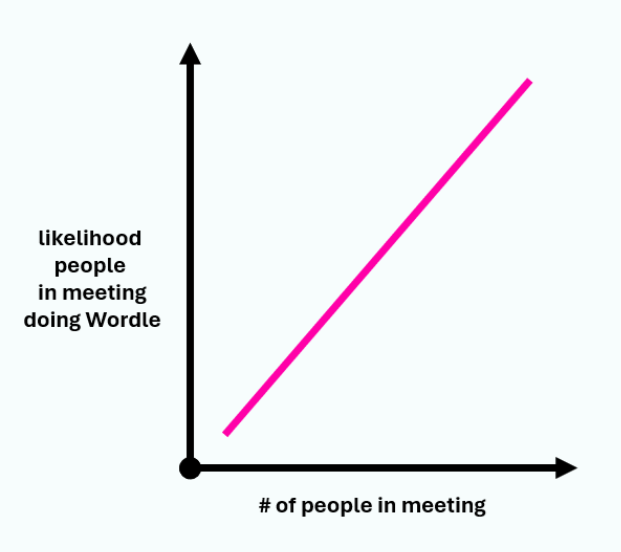
Fun enough for the attendee. But not the working behavior the organization wants.
Big meetings and email chains breed another inefficiency. As communications get larger, the pressure on any one person to respond or act lessens. This diffusion of responsibility — “I’ll let someone else take this one” — sows confusion and drags decision-making.
… and mentally draining …
Alas, communication hypertrophy doesn’t just hurt your efficiency; it eats your soul.
Among its symptoms is “Zoom fatigue” — the feeling of exhaustion from too much videoconferencing. A 2024 Nature study also finds that Zoom-fatigued workers display increasing conformity. The cousin phenomenon “ping fatigue” describes the mental weariness caused by receiving constant email notifications.
Employers should care too. An unhappy, spent workforce is less productive than a happy one.
Alas, communication hypertrophy doesn’t just hurt your efficiency; it eats your soul.
… and create legal issues.
Inefficiency and fatigue are problems familiar to all employees. But for in-house lawyers, communication overload presents other, unique concerns.
The bigger an email chain, the more likely third parties or other unintended recipients are included. Big email chains just feel less sensitive and confidential. And it takes just one well-meaning lay colleague to copy in a client or vendor for their opinion on a contract’s interpretation. (It happens.)
That’s a legal problem. Disclosure to third parties destroys attorney-client privilege; work-product protection vanishes when you put materials in your adversary’s hands.
Separate from those concerns, massive chains and emails also make massive headaches for e-discovery. They mean that many more documents to gather, and that many more potential custodians and deponents.
Inefficiency and fatigue are problems familiar to all employees. But for in-house lawyers, communication overload presents other, unique concerns.
Easier said
Problems are easy to spot, solutions hard to effect.
One reason is that diffusing responsibilities among a group, while inefficient for the organization, might be exactly what the employee wants. It means less responsibility and accountability on them.
Meetings are also easy. Writing requires us to distill our thoughts and organize them into a structure. In meetings we can just jaw.
In addition, sending and receiving lots of emails and joining many meetings makes us feel — and more importantly, seem — busier. They’re opportunities to perform busyness. And the broader the audience the better.
Of course, many workers would rather perform real work. But people are nice and tend to eschew conflict. So, most don’t ask to be dropped from a chain. Instead of declining a meeting invite, they dial in and try for a “Perfect!” in Connections.
After all, no one would be so rude as to reply-all that a chain or call is too inclusive.
Well, almost no one.
Rudeness to the rescue
How employees communicate and meet — and the impact that makes on efficiency and morale — may seem a matter for operations and HR, respectively.
But a company’s lawyers are also well-suited to guide communication behavior.
Whatever their legal field, in-house lawyers must manage conflict. Litigators thrive in adversarial settings. But transactional attorneys likewise need to navigate tension and disagreements as they work their way toward a deal. Other legal roles, whether in compliance or employment, similarly tackle tough situations daily.
That experience should make lawyers less shy about chiming in to slim down chains and meetings, even when it risks ruffling feathers. Remember too, we have a legal reason to do so: enormous chains and meetings risk compromising attorney-client privilege and work-product protection.
Besides, businesses expect their lawyers to be a bit gauche and direct. So, if feathers get ruffled, the reputational damage is slight. They’re just lawyers being lawyers.
Remember too, we have a legal reason to do so: enormous chains and meetings risk compromising attorney-client privilege and work-product protection.
Conclusion
Email and meeting overgrowth is best cured by the entire leadership. Both in their explicit guidance and through their own behavior, management should encourage tight, focused communications.
Still, in-house counsel can do their part. So next time someone decides to blast an email to half the company, strap on your cape and take action.
Disclaimer: The information in any resource in this website should not be construed as legal advice or as a legal opinion on specific facts, and should not be considered representing the views of its authors, its sponsors, and/or ACC. These resources are not intended as a definitive statement on the subject addressed. Rather, they are intended to serve as a tool providing practical guidance and references for the busy in-house practitioner and other readers.