
Banner artwork by TippaPatt / Shutterstock.com
Cheat Sheet:
- AI adoption is a leadership challenge, not just a tech upgrade. It requires diagnosing pain points, building trust, and managing change thoughtfully.
- Prompting is the new core legal skill. Effective prompting determines whether AI delivers actionable, reliable legal outputs or just noise.
- Start small, scale smart. Begin with general-purpose AI tools, prove ROI, and only later invest in specialized platforms.
- The payoff is transformation. Done right, AI empowers legal teams to become faster, more business-aligned, and more strategic — redefining in-house counsel as supercharged generalists who design systems, not just documents.
A new mandate in a high-pressure environment
It’s 7 pm, and you’re digging out from under a mountain of routine contracts while a high-stakes deal looms. Your CEO has just forwarded you another article on “game-changing legal AI” with the note: “Are we doing this?”
This scenario is familiar because the pressure on in-house legal teams has never been greater. The post-pandemic shift to distributed work models, coupled with an explosion in the power and accessibility of generative AI, has fundamentally altered executive expectations. The C-suite demands a strategic partner who can navigate complex risks and provide forward-looking advice. Business clients, accustomed to the instant gratification of modern technology, expect legal to operate at the speed of commerce. And all of this is expected to be absorbed without a corresponding increase in headcount.
Into this high-pressure environment comes artificial intelligence, promising a revolution. And the hype, for once, is partly real. Early adopters report compelling gains: 91 percent of attorneys using AI said it made them more efficient, according to recently released data from ACC, and in the US, the number of professionals already using GenAI more than doubled in one year, from 23 percent in 2024 to 52 percent in 2025. But simply “switching on” AI without a rigorous and thoughtful framework can backfire, creating significant risks around privacy, accuracy, and quality that can damage both the department’s and the company’s reputation.
To harness AI’s potential, we must treat its adoption not as a technology project, but as a leadership challenge. This article provides a comprehensive framework for doing so, guiding you through a four-part journey from initial diagnosis to strategic transformation. It is based on the author’s experience on the front lines of a Fortune 500 company’s corporate legal department.
And I should confess: This article itself was produced in collaboration with AI. It helped brainstorm, surface sources, and organize arguments, but the final judgment, voice, and accountability are mine. This, in essence, is the model for successful AI adoption: a powerful analytical ally that amplifies, not replaces, the expert lawyer.
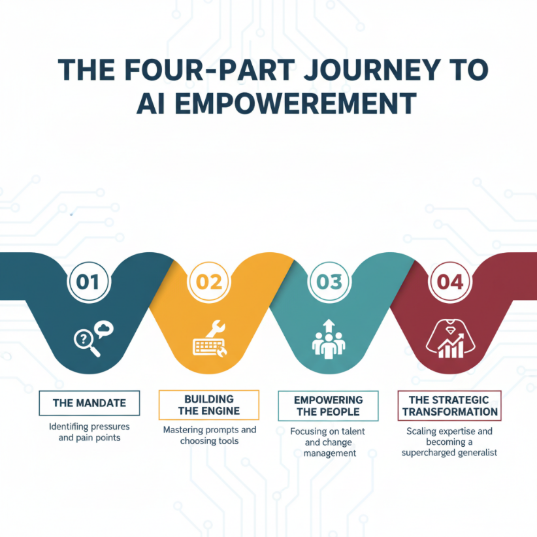
Step 1: Start with the pain, not the tech
The most common mistake in technology adoption is starting with a solution in search of a problem. The first step in a successful AI strategy is not choosing a tool; it’s a deep and honest diagnosis of your department’s biggest friction points. Where are you in the bottleneck? Where does legal become a black box to the rest of the business? By focusing on solving known, painful problems first, you build momentum, demonstrate immediate value, and earn the trust required for broader transformation.
The best starting points are almost always routine, time-consuming, high-volume documents that slow the business down. These friction points typically fall into one of three categories:
The velocity problem
This is the most visible pain point for sales and procurement teams. Consider the standard Non-Disclosure Agreement (NDA). While legally straightforward, the process of drafting, negotiating, and executing hundreds of NDAs creates a massive cumulative drag on the business. Imagine a “Q3 sales crunch” where a dozen account executives are waiting on legal to turn around routine NDAs before they can even begin serious commercial discussions. Each day of delay is a day of lost opportunity. Solving this velocity problem with AI doesn’t just make legal faster; it directly accelerates revenue generation.
To harness AI’s potential, we must treat its adoption not as a technology project, but as a leadership challenge.
The volume problem
This is the silent killer of attorney productivity. Think of the sheer volume of routine letters and notifications the legal department is responsible for.
In practice: One in-house team targeted this by building a multi-modal tool using Google Gemini for termination letters. An internal client manager can now provide a few bullet points in a form or even short audio notes summarizing the context. The tool, trained on the company’s specific legal requirements and tone, instantly produces a high-quality, legally sound first draft. This reduced a 60-minute process involving multiple stakeholders to under 10 minutes.
The synthesis problem
In an increasingly complex regulatory landscape, a significant part of an in-house lawyer’s job is to consume, understand, and translate vast amounts of information for business stakeholders. Summarizing new privacy regulations, analyzing a long litigation report for the board, or even transcribing and pulling key takeaways from an expert witness deposition are all synthesis problems. AI excels at this, providing accurate summaries and first drafts in minutes, allowing the lawyer to focus their energy on the strategic implications of the information, not the manual process of summarizing it.
Step 2: Master “garbage in, garbage out,” or the art of prompting
Think of GenAI as the most diligent, tireless, and slightly naive first-year associate you’ve ever met. A vague instruction (“review this document”) will yield a vague, unhelpful answer. A structured, context-rich prompt — like briefing an associate with specific issues to spot and a clear format for the output — produces useful, actionable work product.
The difference is stark:
Poor prompt: “Is this contract okay?”
Improved prompt: “Review this vendor agreement against our company playbook, focusing on indemnity, limitation of liability, governing law, and data security. Flag any deviations from our standards in a bulleted list, explain the business risk of each deviation, and suggest our preferred fallback language.”
Mastering the art of prompting is the single most important skill in leveraging AI effectively. To do this at an enterprise level, you must move beyond individual ad-hoc efforts and build a centralized prompt library. This is a curated, version-controlled repository of best-in-class prompts for your department’s most common tasks. It ensures that every member of the team is using the same high-quality instructions, leading to consistent, reliable outputs. This library should be a living document, constantly updated with new techniques and refined prompts as the team’s skills evolve
Step 3: Choose your arsenal — the AI tooling maturity model
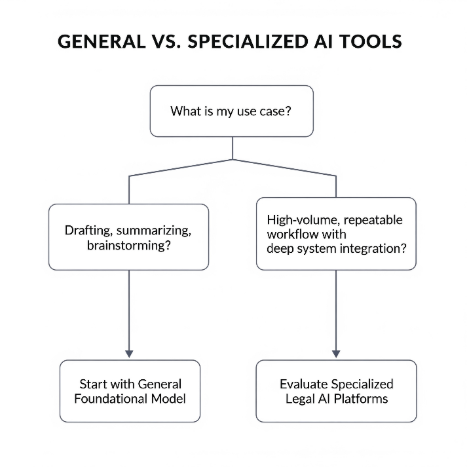
The choice of tools should follow a logical progression from experimentation to sophisticated integration. Jumping prematurely to expensive, specialized platforms is a common mistake. A more strategic approach follows a three-phase maturity model.
Phase 1: Experiment and learn (general tools)
Start with what you have. For many of the initial use cases identified in Step 1, the enterprise versions of general-purpose models (e.g., Microsoft Copilot, Google Gemini Advanced, ChatGPT Enterprise) are more than sufficient. They are flexible, relatively low-cost, and allow your team to build foundational prompting skills on low-risk tasks. By proving the ROI with tools you may already be paying for, you can build a powerful business case for future investments.
The first step in a successful AI strategy is not choosing a tool; it’s a deep and honest diagnosis of your department’s biggest friction points.
Phase 2: Build and customize (custom applications on general foundations)
Once you understand the fundamentals, you can build your own simple, high-impact tools using the APIs of these general models. This is where you create specialized applications built on a general foundation.
In practice: A legal team built automatic amendment and change order generators. A business user uploads the original agreement and enters the desired changes (e.g., “Extend term by 12 months,” “Increase fees by five percent”). The tool, using a generative AI model, parses the original contract and drafts a legally compliant amendment reflecting only those changes, ready for review in seconds.
Phase 3: Buy and integrate (specialized platforms)
You only invest in expensive, third-party specialized platforms (like a commercial CLM with an AI-powered Word plugin) when your needs become so complex or integrated that building it yourself is no longer efficient. These tools are valuable for their deep integrations and pre-built workflows, but they should be a mature, second-step investment for scaling a proven use case, not a starting point.
Regardless of the tool, a rigorous diligence process is non-negotiable. Key checklist items include data protocol, security and ownership terms, source transparency, and integration capabilities.
Step 4: The supervising partner — human oversight is non-negotiable
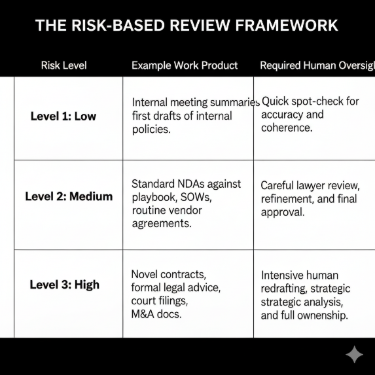
AI is a powerful force multiplier, but it lacks judgment. It can’t detect nuance or discern the “hallucinations” (fabricated information) that have led to lawyers facing professional discipline. Your role is that of the supervising partner — reviewing, refining, and owning the final product. At the end of the day, the work bears our name, our reputation, and our accountability.
Step 5: Protect the pipeline — developing junior talent in the age of AI
A critical question emerges: If AI handles the basics, how will our junior lawyers learn? The traditional apprenticeship model is being disrupted. We must protect these training opportunities by proactively evolving their role.
Shift from “drafter” to “director”
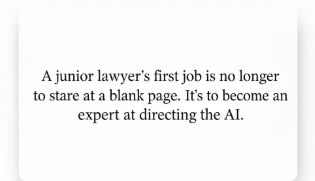
A junior lawyer’s first job is no longer to stare at a blank page. It’s to become an expert at directing the AI — crafting sophisticated prompts, critically analyzing the output for flaws and biases, and making strategic refinements. This shifts their value from manual labor to critical thinking.
Use AI as a Socratic tutor
Train your team to use AI interactively to accelerate their learning. A junior associate can ask, “Summarize this new privacy law for a business audience,” and then follow up with, “Explain the legal precedent for that data retention rule.”
Create high-value apprenticeships
With AI handling the mountain of routine work, you and your senior lawyers have more time for strategic positioning and complex negotiations. Bring your junior talent into those meetings. Let them shadow the work that AI cannot do.
Step 6: Lead the change — navigating a culture of skepticism
AI adoption is not a “set it and forget it” project; it requires a cultural shift. Lawyers are, by training and disposition, skeptical and risk-averse. You cannot simply announce a new tool and expect it to be embraced. You must lead the change proactively.
Appoint champions and run workshops
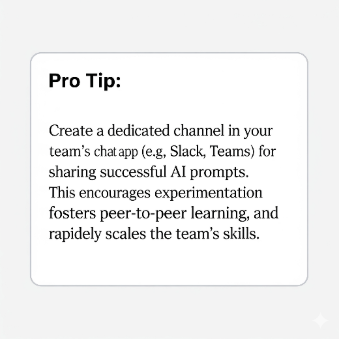
Identify the early adopters and tech enthusiasts on your team and empower them to lead training sessions. Peer-to-peer learning is often more effective than top-down mandates.
Create feedback loops
Establish clear, simple channels for the team to report what’s working, what’s not, and where they see new opportunities. This makes everyone feel like a part of the process.
Lead by example
Acknowledge your team’s concerns about risk and job security openly. Highlight early successes from pilot programs, focusing on how a tool made a lawyer’s life easier or freed them up for more interesting work. Most importantly, visibly use the tools yourself.
Step 7: Scaling legal expertise — from gatekeeper to enabler
This is where the true strategic transformation occurs. Once the engine is built and the people are empowered, the legal department can shift its fundamental role from being a gatekeeper of legal work to an enabler of the business. The new mantra is: Legal curates the rules; AI empowers the business to follow them at speed. This is achieved in-part by building AI-powered self-service tools that scale legal expertise across the entire organization.
The self-service contract triage tool
Imagine a salesperson who uploads a customer’s contract to an internal portal. The AI instantly analyzes it and provides a risk score: Green (auto-approved), Yellow (provides pre-approved fallback language for the salesperson to negotiate), or Red (automatically routes to legal). The deal moves forward in minutes, not days.
In practice: A team built a tool that walks business users through redlines on third-party paper. The user uploads a redlined contract. The AI analyzes the changes and provides a simple, color-coded summary. For each redline, it: 1) explains the change in plain English, 2) describes the business risk based on the company’s legal playbook, and 3) recommends the company’s preferred alternative position, often providing the exact clause to copy and paste. This empowers the business to handle low-risk negotiations themselves.
The policy-trained chatbot
A chatbot on the company intranet can be trained on all your corporate policies. An HR manager can ask, “What are the specific documentation requirements for a performance improvement plan in California?” and get an instant, accurate answer with links to the relevant policies. This provides instant answers to common questions, freeing up the legal team from repetitive advisory work.
Step 8: The strategic payoff — the supercharged generalist
Done right, this framework leads to a fundamental redefinition of the in-house lawyer’s role. As AI and self-service tools competently handle the specialized, routine tasks, they free lawyers to become true supercharged generalists again. With AI as your co-counsel, you can gain competence in new areas of law or business in hours, not months. This re-establishes the legal department as a strategic hub of the business, with lawyers who have the time and capacity to engage in the complex, cross-functional work they were hired to do.
Your role evolves from the person who drafts the document to the person who designs the system that drafts the document.
Your roadmap for responsible empowerment
The future belongs to legal teams that treat AI not as a magic box, but as a governed, disciplined partner. The lawyers who thrive will be those who lead with these tools, not those who fear them. By building a rigorous framework focused on solving real pain, empowering your people, and scaling your expertise, you can deliver faster results, empower your business clients, and reposition your lawyers as the supercharged, strategic advisors the business needs them to be. AI may draft, summarize, or analyze, but at the end of the day, the work bears our name, our reputation, and our accountability. Use it wisely.
Disclaimer: The information in any resource in this website should not be construed as legal advice or as a legal opinion on specific facts, and should not be considered representing the views of its authors, its sponsors, and/or ACC. These resources are not intended as a definitive statement on the subject addressed. Rather, they are intended to serve as a tool providing practical guidance and references for the busy in-house practitioner and other readers.