

CHEAT SHEET
- Accept the challenge. Actively seek roles that will challenge you and expose you to areas of law that will develop you professionally.
- Take a breath. Take a moment to slow down and assess if the opportunity is in line with your personal and profesional goals.
- Learn the culture. The six components of a great corporate culture are vision, values, practices, people, narrative, and place.
- Reflect. Ask yourself the hard questions before moving forward. Do you have the management and operational skills needed for the leadership role? Can your support structure withstand the transition?
Congratulations, you were chosen for, or are about to be offered, a new role. You worked hard and stood out from other candidates for this leadership role. Having impressed the powers that be, you are now awarded with a fantastic leadership opportunity. Somebody, somewhere, thought it was a good idea. Now it’s time for you to decide whether to make the leap to a leadership role in an in-house legal department. Welcome to the vertical leap.
Being considered for a leadership role
This article assumes that you have been chosen for a new leadership role. If you have not yet been chosen to ascend to a leadership role, here are several things you can do to help you stand out for consideration.
- DELIVER. Of course, you must deliver top performance. To move up, you must show mastery of your current role.
- CREATE. Show that you can be a change agent. Think of ways to streamline, improve, and simplify. Be an innovator.
- STAND OUT. Be seen and make sure it’s not for the wrong reasons. Don’t be a wallflower. Step up and volunteer. Voice your opinions and suggestions, but be respectful. Do not be afraid to toot your own horn — if you don’t illustrate your achievements no one else will.
- THINK BUSINESS. Think big picture. Always think of ways to save money, time, and resources.
- LEAD BY EXAMPLE. Motivate, don’t demoralize. Be at the head of the pack and in the trenches.
- GET A MENTOR. Whether you call it a teacher, guru, mentor, advisor, or counselor, find someone who has successfully made the leap and talk to them regularly. Get ideas from them on how they did it.
Many in-house lawyers dream about making this decision. There are many titles. Besides general counsel and chief legal officer, some companies call these roles executive directors, legal directors, head of legal, vice president of legal, or simply head lawyer. Whatever the title may be, a leadership role in a legal department usually consists of (1) oversight and responsibility of a specific scope of legal issues; (2) leading a team of legal staff; (3) management of a budget; (4) responsibility for team/department performance; and (5) a direct reporting relationship to one or more members of senior management.1
Moving into a leadership role in a legal department is a big step. It’s a great experience, but you should not take it lightly, regardless of your pedigree, experience, or background. The decision to accept or decline this role is something that should be weighed carefully. This decision will obviously have a huge impact on your career.
If you are thinking about making a vertical leap, there are some things that you should contemplate. Consider the move in its totality. Are you making a leap to lead another company’s legal department or receiving a promotion at your existing employer? Critically analyze every aspect of your current situation and your potential future state. Make a decision that is best for you and your life goals.
Emotions run high during the interview and negotiation period, especially if this is a candidate’s first leadership position. Many candidates get caught up in the euphoria of being one of the last candidates considered or even the chosen one. They may let their emotions get the better of them and accept an offer they haven’t really considered carefully.
My sincere advice is to slow down, take a deep breath, and assess the situation. Sometimes the roles you walk away from are just as important to your career as the ones you accept. I have walked away from several roles that I did not feel were in line with my personal or career goals for one or more of the reasons below. I have also walked away from a role because, even though I made it through all the interview hoops, I honestly felt that it was truly out of my league, and I would have crashed and burned. I still stand by that decision and feel it saved my career.
1 This is by no means an exhaustive list. There may be many other factors but these are the most common in a legal department leadership role.
First, stop and ask why
Analyze why you are making a move. Some individuals take these roles for all the wrong reasons and quickly learn that it was not the right time for them. If this is your first leadership role in a legal department, you should really stop and reflect on exactly why you want the role. More money? Prestige? Does the title give you a warm, fuzzy feeling that you have “made it”? For most people, a little of all the above is true.
Set aside your emotions and make a detailed list of the pros and cons of the move, including personal, financial, and professional dimensions.2 Really think through the motivation for your leap. Hopefully, this article will help give you some things to consider. This is an extremely important decision, and one that should be weighed with a cost/benefit analysis.
Make sure the reasons you’re leaving are positive, not negative. In other words, don’t leave a position just to get away from an unpleasant situation. Make sure you are leaving for positive reasons. Hopefully, this is the next step in your professional development, and it is in line with your financial and career goals. You should be leaving with a smile and a handshake. Take all your relationships with you for the rest of your career. Never burn bridges.
2 You should compare apples to apples and list all compensation, including benefits. You should also consider your travel time, vacation days, car/gas stipend, employee discounts, perks, etc. Everything! List them for your current and prospective role and critically analyze the differences including these in the pro/con analysis.
Why break the status quo?
Answering the “why” is the most crucial aspect before making your move. I’m not trying to talk you out of a move, but a vertical leap can stagnate your career just as easily as it can fast-track it. Making a move for the wrong reasons and getting canned from your new role because you lack the skills, weren’t prepared, or because your heart isn’t really in it will not look good on a resume.
What kind of gig is it?
I can’t stress the importance of understanding your new scope of responsibilities upfront, not just for performance reasons, but also for your personal development as a lawyer. It is also important to know where lawyers shake out in the organization’s hierarchy. When it comes to leadership positions in a legal department, there’s a very wide spectrum regarding the scope of practice3 and status4 for those roles. Figure A below illustrates how these roles can be ranked on a four-quadrant matrix.
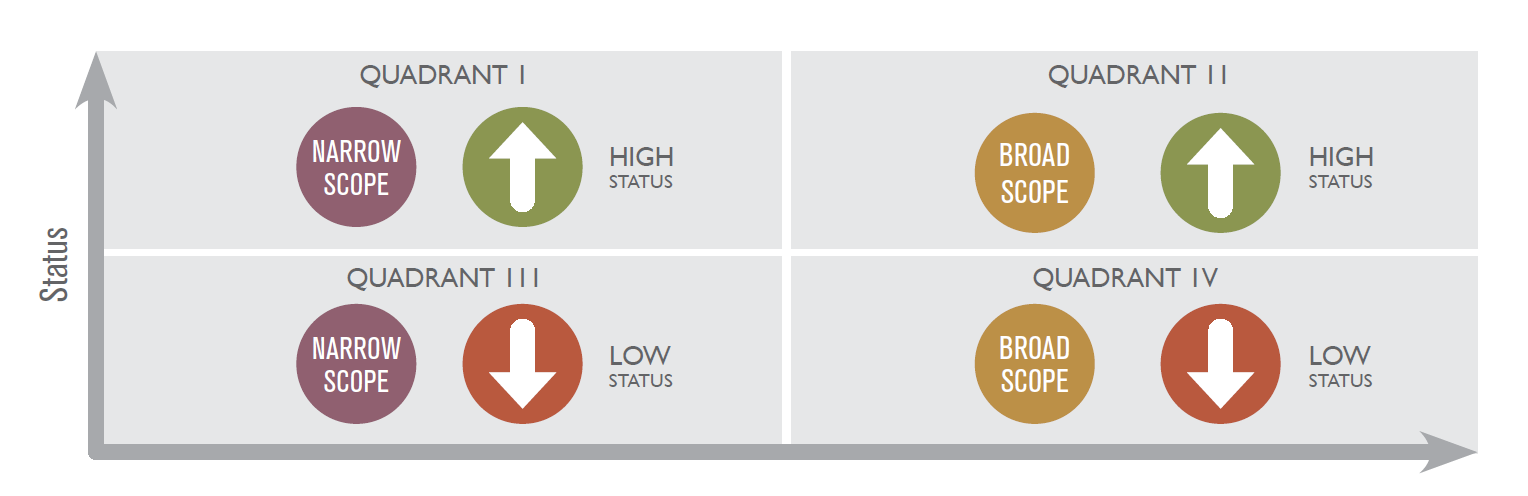
Each leadership role will have a ranking somewhere within the matrix. Quadrant I contains roles with a narrow scope of practice and a higher status within the organization, like a general counsel dedicated to a practice area. Quadrant II contains roles with a broad scope of practice and a higher status within the organization, like a chief legal officer. Quadrant III contains roles with a narrow scope of practice and a lower status in the organization. Quadrant IV contains roles with a broad scope of practice and a lower status in the organization.
Make sure you know where the leadership role lies within the matrix and, more importantly, whether you are OK with this. Disappointment arises when you expect to be in one quadrant but find out that you are actually in another. Better to be clear upfront than surprised later. Ask lots of questions during the interview phase and make sure this new position is going to be a step up [see below for examples].
Some companies carve out securities work, IP, corporate governance, mergers, acquisitions, and divestitures, and other areas and assign those to different functions. Other companies, including many non-US corporations, may see lawyers as glorified paralegals.5 Make sure your new role will include practice areas that you want to continue developing or begin to develop. Actively seek roles that will challenge you and expose you to areas of law and experience that will satisfy and develop you professionally.
Just like weightlifting increases the size of your muscles, this new role should increase your skill level. I strongly advise you to seek a leadership role that will expose you to challenging areas of law, senior executives, and board members. You should be exposed to practice areas you desire to gain experience in and that you find interesting. Take a step forward.
If the new general counsel role has a smaller scope of practice than your existing role, then seriously consider the move. What will your future skill level be in five years if you accept? A title may sound good, but your skill level will likely suffer in the long run if it’s a step down. You may end up regretting it. On the other hand, if taking a leadership role that requires less time and energy is the planned strategy for you (more family time, more time for a side gig, etc.) then that is a different story altogether.
3 “Scope of practice” refers to the scope, jurisdiction, and breadth of responsibility the leadership role has with respect to legal matters within the organization. Having responsibility for contract work within the United States is a much narrower scope of practice then handling all legal issues for Europe.
4 “Status” refers to the prestige, power, influence, and rank that the leadership role has within the company’s organizational structure. Is the role expected to attend executive meetings? What about board meetings? Does the role have a place at the executive table?
5 In many foreign-based companies, general counsel and other legal department leadership may be ranked somewhere in Quadrants III or IV.
What is the culture like?
Culture is one of the most important aspects of any corporation. If you are moving up in your existing organization, you probably have a good idea of the culture. But if you are moving to a new company, this is an extremely important element to consider. In his article, “Six Components of a Great Corporate Culture,” John Coleman describes what components make a great corporate culture.6 Coleman explains that “vision, values, practices, people, narrative and place all converge to make up a corporation’s culture.” Understanding and paying attention to these six components allows one to get a feel for that company’s culture. This is something to which you will want to pay close attention.
What is the company’s vision? What are the company’s values? What are the people like? What is the history and story behind the company? What was the interview and negotiation process like? What do the building and office environment look like? These are all clues you should be paying attention to as you explore this role further. Bad cultures usually create miserable working environments.
Good due diligence can smoke this out, but sometimes it’s difficult to detect during the interview and negotiation process. You can also view a company’s reviews on Glassdoor.7 Many companies will strategically hide this to get good talent. Be sure you ask a lot of questions and pay attention to key indicators of culture.
6 www.hbr.org/2013/05/six-components-of-culture.
Determining the scope or status of leadership roles
Read the job description carefully.
- Will you grow in this role? Will this role challenge you? Will you develop any new skills in this role?
- Are the base compensation and benefits “at market”? Check at least three different sources.
- Are there any perks?
- Will there be an internal/external announcement of your hiring?
- Understand what areas of law the legal department handles.
- Find out if there any areas of law handled outside the legal department (i.e., intellectual property or corporate governance).
- Does the legal department handle compliance?
- Does the legal department handle any non-legal areas?
- How much room is there above you on the organizational chart?
- Who does the role report to?
- How many direct reports does the role have?
- Does this role get an office? Where is the office located?
- Does the role sit on any management committees?
- Does the role interact with the board of directors or any of its committees?
- Does the role require any approvals when hiring/firing outside counsel?
- What is the role’s monetary signature authority? (Yes, ask!)
- Get an in-depth understanding of how the legal budget is funded.
Do you honestly and objectively have the required experience?
It’s time for serious self-reflection. Do you really have the experience needed for this leadership role? Only you can answer this question. Make sure you have the experience required before jumping into the next level.8 Usually, you won’t be able to “fake it until you make it” based on the skills and responsibilities required. Again, moving into one of these roles if you are not ready can end up being a disaster for you and your career. Knowing what you don’t know is a rare and invaluable wisdom.
I was extremely lucky to work with several legal department leaders who were down-to-earth, open, honest, and willing to answer any and all the questions I had. They were also good leaders and included me in the decisions they made (both legal and operational) and the reasoning behind their decisions. They taught me a lot.
This mentoring helped me a great deal when I made my leap. Many are not so lucky and are clueless when facing new responsibilities to create or balance a budget, give performance reviews, deal with team rifts, keep senior management up to speed on legal affairs, and other routine leadership responsibilities. You should ask your current leaders questions in these key areas.
Many lawyers at this level are excellent technically, which is why they are considered for leadership roles. However, they do not possess the management or operational skill levels necessary for these positions. These subjects are not taught in law schools. If candidates possess these skills, they were usually learned through prior work experience from their leaders.
If you are inexperienced, actively seek to increase your knowledge in these areas. Network with other legal department leaders and ask them questions. ACC’s conferences and chapters are a terrific opportunity to do this. Many are willing to share their insights on managing and operating a legal department. The good news is that you can do quite a bit to improve your operational and managerial skills with the right focus.
8 This situation (hiring a lawyer that lacks required skills or experience) usually arises when the hiring team has no legal expertise or is not using a subject matter expert like a recruiter, a candidate is promoted from within and “given a shot” or an inexperienced lawyer sells themselves dynamically to the hiring team. Sometimes this works out other times it’s a bust.
Do you have any operational experience?
Peter Drucker said, “If you cannot measure it, you cannot manage it.”9 Start thinking of a legal department as a business. Ultimately, you will be required to justify your department’s headcount and budget and convey performance to senior executives. Larger legal departments usually have individuals or a team dedicated to operations. Legal department operations are becoming more important as companies look to legal departments to run themselves like other functions in the business.
Many brilliant lawyers step into leadership roles permanently wearing their lawyer’s hat, incapable of removing it and putting on the legal operator’s hat. You will have to start thinking of the legal department as a business function. You will need to become familiar with metrics and key performance indicators for your department. You will also need to know which metrics will convey performance to your executives.
ACC offers courses, forums, articles, and conferences dedicated to this topic. There is also an ACC Legal Operations section. Keep these resources at arm’s length as they will assist greatly in getting you up to speed on operations.
9 Peter Drucker was an Austrian-born American management consultant, educator, and author, whose writings contributed to the philosophical and practical foundations of the modern business corporation.
Do you have any management experience?
In your new role, you will be responsible for overseeing and motivating a team of legal personnel. Performance reviews, daily drama, pitches for raises, vacation scheduling, and more will all be up to you now. If you’re lucky, you will already have experience with this. If not, you are in for a steep learning curve.
Many lawyers are not good at managing legal staff. This is also something not taught in law schools. We are taught to compete with one another, not work on teams or lead each other. Many law firms and corporations routinely bring in consultants and gurus to provide training on management and leadership. If you’re lucky, you’ve attended some of these over the years. Hopefully some of that has sunk in.
What kind of manager are you?
What kind of leader are you? Have you taken any training on management or leadership? This is something many lawyers have trouble with simply because they do not focus in this area. Gaining knowledge in this area is key to making the leap. I highly recommend reading 42 Rules for Your New Leadership Role, 2nd Edition: The Manual They Didn’t Hand You When You Made VP, Director or Manager by Pam Fox Rollins. The author is highly experienced and regarded in the area of onboarding new leaders.10 The book helped me prepare for my leadership role in a realistic way with eyes wide open.
Additionally, ACC offers many resources here as well, with articles, courses, and conferences dedicated to the leadership of a legal department. These are excellent resources to review during your consideration.
10 https://ideashape.com/executive-coaching/
How’s your business acumen?
Those who have mergers and acquisitions, finance, accounting, or business backgrounds have an advantage here. However, if you have no idea what IRR, CAGR, ROI, or working capital is, you need to brush up on your finance-speak. Senior management will need you to understand these and other terms as you help them work through legal issues involving tax, finance, and accounting. If you look like a deer in the headlights when these and other terms are brought up then, trust me, your business clients will pick up on your lack of understanding.
Not understanding these terms will alienate you from your senior executive and finance team. They will seek guidance elsewhere. Eventually, you will lose your place at senior management’s table, and it will take a long time to get your place back. Drop the ball on these guys, and you’ll have trouble getting more budget for anything.
As with operations and management, there is a lot you can do to educate yourself in accounting and finance. There are a number of courses you can take to start brushing up on your financial acumen. Many universities offer online financial courses, including Harvard University.11 ACC offers many courses along these lines as well as catered specifically for in-house counsel, including their mini-MBA course and Corporate Counsel University®.
Many in-house counsel are getting full MBAs. An MBA program offers an excellent education in management and business, although some specialize in other areas. Many MBAs are offered through executive programs for busy leaders so you can attend at night and on the weekends to avoid taking time off from work.
Do you have executive presence?
Ask yourself what kind of presence you have at work. I highly recommend reading the book Executive Presence: The Missing Link Between Merit And Success by Sylvia Ann Hewlett. Like it or not, your appearance, communication, and gravitas12 have a great deal to do with how you are perceived as a leader and a member of the leadership team. Hopefully, interaction with the leadership team is a major factor in your new role. If so, the quality and quantity of that interaction will be a major deciding factor in your success or failure, especially in a general counsel or chief legal officer role.
As far as appearance goes, company culture and dress code will play a huge role in your wardrobe to come. As a lawyer and a leader, you should plan on dressing professionally and being well-groomed. My advice is to plan on dressing one level above the company’s current dress code. Unless you already dress professionally, consider investing in a wardrobe overhaul as part of your cost/benefit analysis.
With respect to communication, being an effective presenter is important. I repeat, practice presenting! Read anything and everything by Nancy Duarte.13 I also recommend visiting Decker Communications at www.decker.com to enroll in classes and seminars on presenting information. Dale Carnegie also offers an excellent program called High Impact Presentations, which is an excellent course on persuasion and presentation.14 These are great resources to improve your internal communications with senior management.
Hewlett does a much better job of explaining gravitas than I can. Some call it moxie, fortitude, mettle, or even guts. A senior executive once described it to me as, “The ability to make others never ever forget you.” Whatever you call it, make sure you work on developing a presence that exudes competence, focus, and professionalism.
12 Hewlett defines “gravitas” as a combination of six things: (1) confidence and grace under fire; (2) decisiveness and showing teeth; (3) integrity and speaking truth to power; (4) emotional intelligence; (5) reputation and standing/pedigree; and (6) vision/charisma.
14 www.dalecarnegie.com/events/presentation-skills-training.
Do you have the required emotional intelligence?
Whether you refer to it as rapport, a bedside manner, approach, EQ, or emotional intelligence, this factor is extremely important at the leadership level. It’s probably more important than you think. Having emotional intelligence in any corporate counsel role is essential, but it is especially important in a leadership position. I have seen more brilliant in-house lawyers fail because they did not have the required emotional intelligence necessary to deal with business clients than for any other reason out there.
Work is hard enough. Nobody wants to deal with awkward, uncomfortable situations on top of their day-to-day grind. I have personally watched situations that were the physical equivalent of scraping fingernails across a chalkboard. You will be avoided, excluded, and eventually extracted. Do yourself a favor and face this issue if it is a problem for you, no matter how uncomfortable it may be.
You will likely be expected or encouraged to attend golf outings, weekly executive meetings, executive retreats, corporate events, and many other gatherings with the executive staff. Your interactions (or lack thereof) at each of these will be scrutinized, especially in the beginning as you build relationships with each member.
If you want to explore this area further, as a start, I recommend reading Emotional Intelligence 2.0 by Travis Bradbury and Jean Greaves. The book includes a passcode allowing you to take an online assessment called the Emotional Intelligence Appraisal. This test will allow you to assess your current EQ on four dimensions: self-awareness, self-management, social awareness, and relationship management. The book will also provide you with a suggested plan on addressing issues you may have with your EQ. Gauging where you are will allow you to work on weaknesses and use strengths to your advantage.
When I shared my results with several colleagues they were astonished at the accuracy of the report. They immediately took the appraisal as well. After I took the appraisal and read the book it helped me to realize certain behaviors I needed to focus on in order to improve my EQ. Focusing on my own self-awareness has significantly improved my overall EQ and helped me “read” social situations more accurately.
Support structure
In his book, Suzanne’s Diary for Nicholas, James Patterson writes,
“Imagine life is a game in which you are juggling five balls. The balls are called work, family, health, friends, and integrity. And you’re keeping all of them in the air. But one day you finally come to understand that work is a rubber ball. If you drop it, it will bounce back. The other four balls… are made of glass. If you drop one of these, it will be irrevocably scuffed, nicked, perhaps even shattered.”
Leadership positions usually involve more of a time commitment including executive gatherings, travel, and more hours in general. Where you are in your life is a very crucial factor in deciding on accepting a new leadership role. Are you a single person or married? Do you have children? What are their ages? Does your spouse work? If so, who watches the children? These questions are extremely important for your consideration for obvious reasons.
There will most likely be much more time needed for your new leadership role. If you don’t have a good support structure, it could make your new role much more difficult to handle. By support structure, I mean family and friends who understand what you do and willingly do what is necessary to assist you when needed. For example, do you have parents who live close by, or neighbors who can watch the kids when you stay late or attend a corporate event? Does your spouse willingly go to corporate events with you, or do you have to beg and plead?
If you have young children, you may miss out on the plays, t-ball games, dance recitals, and other milestone events. Every choice has consequences and deciding to take one of these roles usually means more work time and less family time. Should you wait until a more appropriate time in your life? Consider this carefully as your family life is very important. Can you really “make it work”?
Look before you leap. Never make a move at the expense of your family life. And never make a move without consulting with your partner or spouse. Family is a glass ball, and — as Patterson points out — it can be shattered.
Be prepared to be prepared
Have a strategy in place to get up to speed as quickly as possible. If the role is with a new company, hopefully you have done a lot of research on the business. If you have good relationships with outside counsel, you might ask them to provide you with a dossier on the new company complete with a litigation profile based on public records. If you’re simply stepping up in the same company, you should already have a good grasp on the business side. Whatever the circumstances, you should be confident that you can hit the ground running.
The first 90 days will be what many affectionately refer to as the “honeymoon”: all smiles, handshakes, and introductions. After that, things get real, and people will look to you to start adding value and making decisions leading your team toward company objectives. You will need to assess your resources, including your team, and make difficult decisions, including decisions on replacement of key vendors or employees.
I highly advise reading The First 90 Days, Updated and Expanded: Proven Strategies for Getting Up to Speed Faster and Smarter by Michael Watkins. This is an excellent resource on transitioning into a new role. I also recommend reading The New Leaders 100 Day Action Plan by George B. Bradt. Both books will help greatly by providing you with a strategy and plan of attack for your new leadership role.
Both of these resources provide key takeaways including taking an organized and methodical approach to assessing and acclimating to your new role. Both these books provide good insight on owning the first 90 days by taking control rather than going with the flow. They include detailed checklists, interview ideas, and key milestones to look for over the first several months as you move into your new position.
What is the new team like?
If you are joining a new company, consider why they did not promote from within. Ask questions about the team you will be managing. What are you stepping into? Will you be faced with a difficult situation where one or more direct reports think they should have gotten the role?
Do your due diligence and determine if the staff size is adequate. Will you be spending a good deal of your time on the day-to-day grind, or will you be focusing on management, strategy, and high-level legal issues for senior executives? Will you have to dedicate time and resources to building a team? Don’t get caught up in the thrill of your new role and forget to address the realities.
If you are being promoted within your company, you may have an advantage in knowing more about your team. In many cases, one shining star is promoted from an existing legal team and that person steps into a leadership role over former colleagues. Consider the challenges in supervising former peers. This is a difficult state of affairs and only the most mature, self-confident, and emotionally intelligent people can handle this situation. You’re usually looking at either a ghost (someone is physically present but mentally checked out) or a potential saboteur.
Do you respect your peers’ work product? Do they see you as a leader? Will they respect you moving forward? How will they handle your critique of their performance? Some excellent resources for this are Managing Friends and Former Peers by Gary Winters or Peer Today, Boss Tomorrow by Laura Bernstein. Both books will provide you with ideas and concepts to help you address this difficult situation. They provide key insights on working issues with peers and good coping mechanisms for those difficult situations.
Do you have any global experience? Will you be given responsibility for foreign jurisdictions? Will you be responsible for management of foreign lawyers or legal staff? If this is your first experience dealing with operational, management, or legal issues outside of North America, be open-minded. Do not step into the role with a North American mindset.
Be respectful of other cultures, opinions, and views. Understand that in many jurisdictions lawyers do not appreciate the professional status they have in North America. Different cultures have very different risk tolerances as well. Tread lightly, shut your mouth, and listen. Ask questions. Observe and always be polite.
I recommend reading Erin Meyer’s The Culture Map: Decoding How People Think, Lead and Get Things Done Across Cultures. This is a great book for trying to understand different cultures and working with people from different cultural backgrounds. Meyers does a great job decoding how these differences have an impact on the day-to-day work in businesses around the world.
Cultural diversity is something that takes practice. Unfortunately, no matter what you read, you will be forced to deal with difficult situations that are sometimes embarrassing. Politeness, flexibility, and willingness to learn will go a long way.
Understand it will be a different role
Lastly, understand that if this is your first leadership role, it is going to be different. You will need to do things differently. A lot differently. Do not plan on doing a lot more of the same thing harder.
I highly recommend reading the book What Got You Here Won’t Get You There by Marshall Goldsmith. This is an excellent resource explaining the differences to expect when stepping up a level. It also includes a list of 20 habits15 that will hold you back in your advancement. After reading this book, I really started paying more attention to what I needed to stop doing to maximize my efficiency in a leadership role. I created a “To-Stop” list, which supplemented (and became more important than) my “To-Do” list. This has helped my career immensely.
Additionally, I really started to focus on recognizing my subordinates’ contributions and allowing them time to speak with and present to senior management. This has helped me establish a better rapport with my subordinates by showing them I actually cared about their ideas and development.
15 © 2007 Marshall Goldsmith, What Got You Here Won’t Get You There, Page 40-41 Hyperion Books.
Conclusion
In-house lawyers making a vertical leap should stop and reflect on this extremely important and pivotal point in their career. Don’t let your emotions get the best of you. Answer the “why” question before doing anything else. Look deep within, determine what your motivating factor is for this move, and make sure it’s positive.
Understand what kind of role it is, and make sure it’s a good fit for you as well as the company. The leadership role should be the next logical step in your career trajectory. This role should be in line with your experience level. Plan on closing any learning gaps in operational and managerial skills as needed. Also, plan on brushing up on your financial acumen if needed.
Be sure to pay attention to the executive presence and emotional intelligence. Both will be extremely important in a leadership role. Strive to honestly assess any weaknesses here and work on countermeasures for those areas.
Keep your family goals in mind when considering the role, and make sure not to drop the ball. Be prepared to have a plan and get up to speed quickly. Do your due diligence, and learn as much as you can about the team and company culture. Don’t bring a small-minded view to your role if it has a global scope. Finally, understand that this role will be different, and you will need to do things differently to succeed.