To support your global practice, ACC Docket offers country-specific fun facts from your peers who've been there — literally.
| Economy | GDP (purchasing power parity) $257 billion |
| Population | 5,699,000 (2015 estimate) |
| Corruption | According to Transparency International’s “2014 Corruption Perception Index,” Denmark was the “cleanest,” (i.e., least corrupt) country out of the 175 surveyed. |
| Economic Forecast | GDP is projected to grow in 2016 and 2017 at just under two percent, supported by investment and a pick-up in world trade. Households will continue to reap the benefits of low inflation and energy prices and a stronger labor market. Exporters will get a boost from the weaker effective exchange rate and stronger growth in the European Union, according to the Organisation for Economic Co-operation. |
| Additional Resources | Magteliten, a book by Anton Grau Larsen, Christoph Ellersgaard, and Markus Bernsen, written in Danish but still very useful for non-Danish speakers, with excellent diagrams and lists of who’s who among the business (powerful) elite. |
| A History of Denmark, a book by Knud J.V. Jespersen, particularly Chapter 8 (The Danes – a Tribe or a Nation?) | |
| Weekly Post – Danish news in English | |
| Cycling Embassy of Denmark for statistics on cycling in Denmark |
As a qualified lawyer, I carry two business cards with me when I meet with Danes. One is for the Danes, and one is for everyone else. The one for the Danes (especially in the legal profession) contains my academic qualification (LLM) rather than just my title. The habit extends to letters to the press and even your obituary.
If I were to totally conform, I would also include in my business card a middle name too — consistent with the Danish style that originates from having too many people named Andersen (the equivalent of Smith). The author of the famous Danish fairy tales is therefore not just plain Mr. Hans Andersen but Hans Christian Andersen.
Business and social occasions start punctually (give or take a couple of minutes). Small talk and networking can be in English, but introductory attempts at Danish are encouraged. If you are in Denmark, it is essential to understand Danish even if you struggle to write it — the written form bears absolutely no relationship to the spoken form, much to the amusement of Denmark’s Scandinavian neighbours. Even with having some language skills, in getting a glimpse into the Danish business world, understanding whose who in the network (in Danish, netværk) is essential. Having local Danish advocates in my team is particularly invaluable in this regard.
Contrary to what many outside Denmark may assume, what you are offered at the meeting is likely to include Viennese pastry (Weinerbrød), which is identical to what the rest of the world calls Danish pastry. If you head off for lunch, either along Nyhavn in Copenhagen or at the office’s canteen, you will likely be served pickled herring in various forms. The Danes also still refuse to take responsibility for the delights of Danish beer, insisting on referring to a Danish pilsner as a bajer, literally a beer from Bayern/ Bavaria in Germany, but taking the credit for sparkling mineral water (danskvand, literally Danish water).
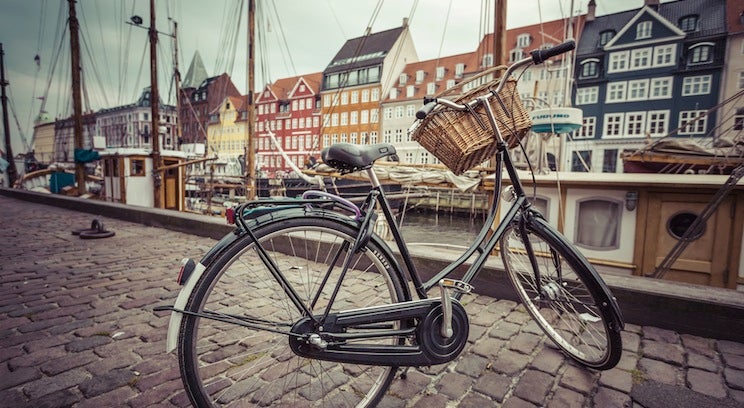
As the meeting ends do not be surprised if even the most senior of lawyers gets on his bike. Yes, 24 percent of Danes really do commute by bike.