To support your global practice, ACC Docket offers country-specific fun facts from your peers who’ve been there — literally.
| Economy | GDP (purchasing power parity in USD) $13 billion |
| Population | 392,718 |
| Corruption | According to its Transparency International’s Control of Corruption score, which reflects perceptions of the extent to which public power is exercised for private gain, The Bahamas falls within the 89 percentile, with a score of 1.354, which means it is less corrupt than the majority of comparable nations or territories. |
| Economic forecast | The governing Progressive Liberal Party’s large legislative majority should support its agenda ahead of elections in 2017. The large scale deficit, increased further by Hurricane Matthew recovery efforts, will narrow slowly as tourism and trade flows recover. Tax reforms have boosted revenue, including via a value-added tax that was introduced in 2015, at a rate of 7.5 percent. Delays to large-scale tourism projects will inhibit recovery in growth, and inflation will remain contained, according to The Economist. |
| Additional resources | The Nassau Guardian, Bahamaian newspaper |
| The Punch, local politico gossip | |
| Bahamian Scenes, a book of dialect poetry by Dr. Susan J. Wallace | |
| Official Tourism Site |
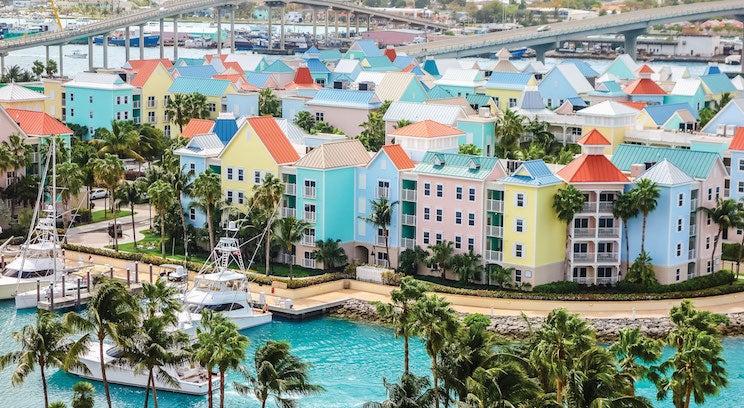
Known for its “delectable” sun, sand, and sea, along with its friendly locals, the Bahamas is a warm and sunny destination eager to do business with the world.
The Bahamas is a winding chain of over 700 sparsely populated islands and cays. Although it’s said to be a Caribbean nation, this is geographically incorrect. Technically, it sits in the Atlantic Ocean — making it a part of the West Indies. The capital is New Providence, but Nassau is its city centre. This is primarily because it’s a mecca for government buildings, legal and accounting firms, as well as commercial and offshore banks. Business, however, is now burgeoning throughout New Providence, with pockets of boutique firms popping up along its eastern and western coasts.
The Bahamas, once a British colony, attained independence in 1973. However, the locals mostly continue to associate wealth and business expertise with expatriates and are very accommodating to foreign investors.
Bahamians are fun loving and friendly people who are often offended if someone steps into a room without greeting with a hearty “good morning,” “good afternoon,” or “good day.” Failing to do this is considered the epitome of bad manners and can derail a positive encounter. Business meetings range from formal to very casual and it’s useful to ask a secretary or receptionist what the dress code is prior to arriving.
Meetings will typically start on time, but expect some invited persons to join 15 to 25 minutes late with the excuse that they’ve just finished up another meeting that ran longer than expected. Meetings often extend much past the agreed agenda. Government agencies are beginning to take advantage of technology to improve efficiencies. It’s best to avoid setting deadlines until after the start of the new year, as the country turns its focus on Junkanoo parades and celebration during the holiday season.