Banner artwork by Summit Art Creations / Shutterstock.com
The year is 2007. A newly formed Silicon Valley company called Twitter is struggling. The social media platform created in 2006 was limping along at 20,000 posts a day and few regular users. It was having a hard time getting attention or funders. The future of the company seemed much in doubt until Twitter attended the 2007 South by Southwest Interactive (SXSW) conference. Many consider this conference as the key moment that turned Twitter (now the X platform) into the platform today used by approximately 650 million people.
How could a conference so drastically change the fortunes of a company that is ubiquitous today but hardly known then? The Twitter leadership set up two monitors to live stream Tweets. They made it easy to sign up via text. The conference participants became quick adopters using Twitter to interact with each other, comment on presentations, or socially connect. Twitter posts tripled from 20,000 to 60,000 as Twitter gained a dedicated follower of users that exponentially increased thereafter.
A key theme is to absorb outside learning into your legal thinking.
If you have followed my series of articles on career development, a key theme is to absorb outside learning into your legal thinking. Corporations are magical places of creativity, focused objectives and accomplishments, and collaboration. But corporations are very insular and act as one of the most powerful echo chambers that I have experienced. If you want to separate yourself from the development pack, an outside perspective is vital. It will round you out making you more worldly from a corporate perspective, give you fresh ideas and lenses, and push back on the echoes within your own chamber.
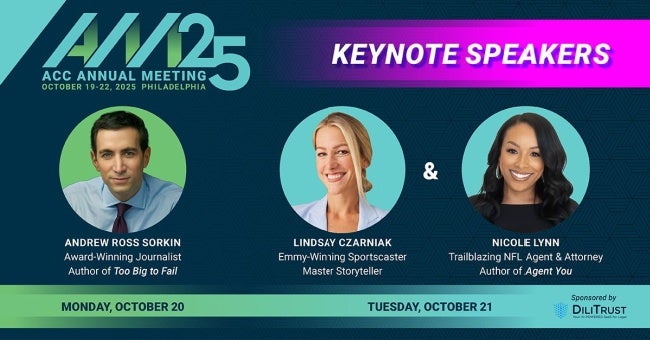
I encourage you to attend the upcoming ACC Annual Conference from October 19-22 in my hometown of Philadelphia to accomplish just that. As an advisory board member to the conference, we have attempted to create the most relevant and update content helpful to you, your job, and your career. As an example, the use of artificial intelligence in our field is exploding, and many panels will dive deep into legal departments’ use of this tool to make our lawyers and lawyering more effective and efficient.
If you want to separate yourself from the development pack, an outside perspective is vital.
Whenever I attend a conference, I try to find one great idea to bring home and test one of my own ideas on the diversity of people and experiences at the conference. Many years ago, I attended a conference when a panelist gave me an idea about Early Case Assessments (ECAs). As many of you know, ECAs are initial litigation evaluation reports on a potential litigation case and how to mitigate the risk of litigation or lower the potential liability before litigation begins. It is a common tool used by legal departments. The idea given to me was that, instead of treating each ECA separately, legal departments should plot all of their ECAs on a heat map showing the likelihood of litigation on one axis and the materiality on another axis. I thought this was a great idea to show the corporations that we serve what really matters as you step back from ECAs in terms of what could be coming around the curve in terms of material litigation. It also helped us focus our time, energy, and resources.
I have asked others to give me examples of the great ideas that they got from conferences. Here is what they had to say:




| Andy Boczkowski, VP of U.S. Litigation, GSK | I am VP of US Litigation at GSK but also chair of our global In-house pro bono program. I make an effort to attend Pro Bono Institute’s annual conference where I interact with several companies of varying sizes, each with its own range of sophistication and formal process put into their respective programs. Most companies are outside my industry. I walk away energized every time. One idea I still turn to today came from a presentation by Microsoft and the Corporate Pro Bono project called “Pro Bono Maturity Model,” which is a tool to assess the evolution of in-house pro bono program. Rather than a checklist of “best practices” that should be followed blindly, the model was more of a tool to make an honest assessment of where you are and whether and how you can go farther. I still use it today to track the development of our program, do benchmarking, and manage internal stakeholders. | |
| Steven Feder, General Counsel, CompoSecure, Inc. | As a long-time securities lawyer, I made a regular habit of attending PLI’s SEC Speaks conference as frequently as possible. Hearing the direct views of the regulatory agency was truly beneficial to my development of subject matter expertise, as well as enabling me to develop effective work and even personal relationships with several current and former staff members. These relationships have served me well over the years as I met the needs of my public company clients in dealing with SEC projects. | |
| Larry Weiss, Chief Legal Officer & Corporate Secretary, AngioDynamics, Inc. | There is a huge value in meetings like the ACC Annual Meeting in being able to hear from others who have handled the issues you’re dealing with every day but from a different perspective. Every Annual Meeting I’ve attended over every stage of my career has left me with new ideas, perspectives, and solutions that helped me back at the office. Beyond that, there’s enormous value in just being in our community. I’ve never regretted attending the Annual Meeting and look forward to being in Philly this October! | |
| Amy Yeung, Executive in Residence / In Transition, Progress Partners | At large conferences, I try to attend one panel that has nothing to do with my areas of expertise. It has opened the door to exposure to new areas of the law, and from individuals who are experts in their field. In one conference earlier in my career, the dialogue shifted from the subject matter and into how to approach internal clients. With different company types, it gave me a chance to compare and contrast some of the in-house counsel expectations, as well as benchmark against my own. I also realized that despite subject matter difference, we also shared similar experiences. |
These reflections show the importance of setting aside the day-to-day work for a few days and attending a conference to gain perspective. It often feels like we do not have time for conferences, or our work takes precedence. I understand those sentiments, but I change my viewpoint when those thoughts enter my head. In its place, I tell myself that I cannot afford to miss the conference because of the next great idea that will help me be more efficient or make whatever work is pilling up have an even more successful outcome. Like for Twitter, a conference be the X that marks a spot in your journey.
Disclaimer: The information in any resource in this website should not be construed as legal advice or as a legal opinion on specific facts, and should not be considered representing the views of its authors, its sponsors, and/or ACC. These resources are not intended as a definitive statement on the subject addressed. Rather, they are intended to serve as a tool providing practical guidance and references for the busy in-house practitioner and other readers.